German Teachers Demand Urgent Action as School Violence Reaches Alarming Levels

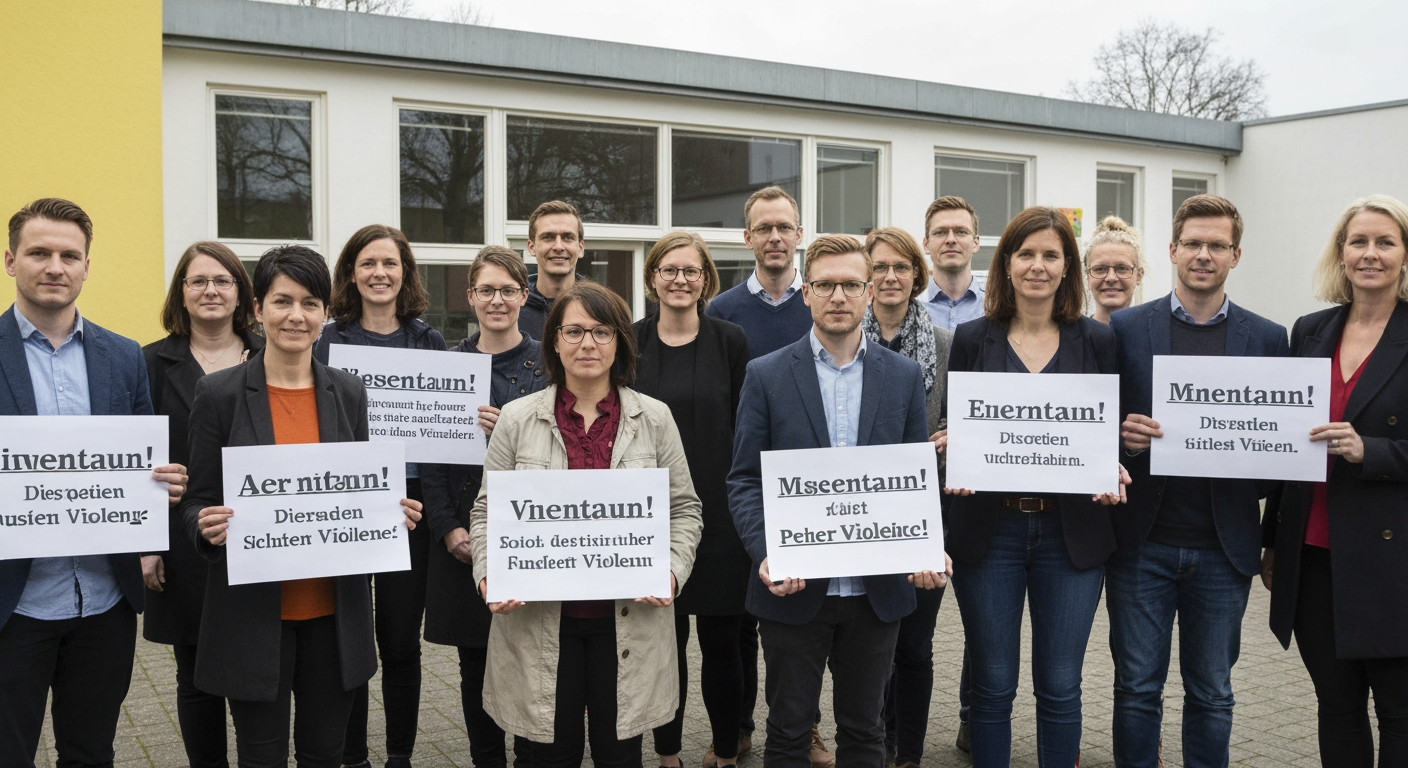
Berlin, Germany – German teacher associations are issuing a dire warning, calling for immediate and comprehensive action as reports indicate a significant and troubling escalation of violence in schools across the nation. New data reveals a stark increase in both physical and psychological aggression, prompting educators to describe a "brutalization in everyday school life" and highlighting profound concerns for the safety and well-being of both students and staff. The alarming trend has led to a critical reevaluation of school environments, with teachers grappling with security risks that now often overshadow traditional pedagogical considerations.
The gravity of the situation is underscored by recent statistics painting a grim picture of school environments. In 2024, authorities recorded 1,283 cases of intentional simple bodily harm against teachers, marking the highest level in at least a decade and equating to more than three attacks per day. This represents a continuous upward trend, with annual incidents ranging from 717 to 1,017 between 2015 and 2023, interrupted only by a dip during the coronavirus pandemic when school closures limited in-person contact. More severe violent crimes against educators have also surged, with 557 cases reported in 2024, including grievous bodily harm, a substantial rise from 268 cases just nine years prior in 2015, effectively doubling in frequency.
An Escalating Crisis in Classrooms
Beyond direct attacks on teachers, the overall landscape of violence within German schools has deteriorated considerably. Between 2022 and 2024 alone, cases of violent crime at German schools surged by almost 40 percent, climbing from approximately 21,000 to 29,000 incidents. In 2023, nearly 27,500 violent offenses, encompassing both minor and severe bodily harm, were documented in schools, representing an increase of roughly a quarter compared to the preceding year. This troubling trajectory is not limited to physical altercations; a 2024 survey indicated that almost half of all teachers (47%) observed issues with psychological or physical violence among students at their own schools, with this figure rising to 69% in socially disadvantaged areas. This widespread perception among educators reflects a systemic challenge that extends far beyond isolated incidents, pointing to a broader shift in acceptable behavior within school settings.
Teacher associations have voiced their concerns with increasing urgency. Udo Beckmann, head of the Association for Education and Training (VBE), stated that violence against teachers is no longer a fringe phenomenon, a sentiment echoed by Stefan Düll, president of the German Teachers' Association, who noted a falling threshold for violence and an increased willingness among pupils to resort to physical means to resolve conflicts. Susanne Lin-Klitzing, head of the German Philologists' Association, has even warned of a "brutalization in everyday school life," underscoring the severity of the cultural shift.
Educators on the Front Lines: A Changing Role
The escalating violence has profoundly impacted the daily lives and professional decisions of German educators. Many teachers report feeling compelled not to report incidents, either due to a perceived lack of consequences for perpetrators or a fear of further escalation, exacerbating the cycle of aggression. This reluctance to report can create a climate of underreporting, potentially masking the true extent of the problem and hindering effective intervention. The continuous exposure to such an environment is taking a significant toll on teacher well-being; the 2024 German School Barometer revealed a high level of emotional exhaustion, with more than a third of teachers (36%) feeling emotionally drained several times a week. This stress and burnout are particularly prevalent among younger and female teachers, as well as elementary school educators.
The increasing prevalence of violence has also forced teachers to fundamentally alter their approach to their profession. Decisions that were once purely pedagogical are now frequently weighed against security concerns. A poor grade, a reprimand, or a disciplinary note, once routine disciplinary measures, can now trigger unpredictable and potentially violent reactions from students. Teachers report carefully considering their responses to certain pupils, not primarily out of educational caution, but out of genuine concern for their own safety. The notion that a student might carry a weapon, such as a knife, is no longer an abstract fear but a tangible possibility that influences classroom management. This shift transforms the classroom from a dedicated learning space into an environment where personal safety is a constant, underlying concern, inevitably impacting the quality of education and the teacher-student relationship.
Calls for Action and Divided Solutions
In response to the escalating crisis, teacher groups and political figures are demanding concrete measures to ensure safer school environments. The German Teachers' Association has called for intensified violence prevention programs and anti-aggression training for students. However, the organization maintains its opposition to the presence of security services equipped with metal detectors in schools, emphasizing a focus on proactive educational strategies rather than punitive security measures.
Meanwhile, political voices are also joining the chorus for action. Marcel Emmerich, the Green Party's domestic policy spokesman, has advocated for improved protection measures within schools, suggesting standardized procedures for handling violent incidents and the implementation of technical safeguards, such as alarm systems. Beyond school-specific interventions, Federal Justice Minister Stefanie Hubig of the SPD has proposed increasing minimum sentences for assaults on public servants, a category that would include teachers, aiming to provide stronger legal protection for frontline workers. A cabinet decision on this proposal is currently pending. These varied proposals reflect a broader societal debate on how best to address the rising tide of aggression in public-facing roles, with schools being a primary focus.
Societal Factors and the Path Forward
Experts suggest that the rise in school violence is not an isolated phenomenon but rather a symptom of broader societal shifts and underlying challenges. The Robert Bosch Stiftung, which published the German School Barometer, described the current situation as a "snapshot of an ailing system," pointing to how teachers have long had to compensate for the consequences of a massive teacher shortage and are continually burdened by new challenges. Student behavior and the complexities of managing heterogeneous classes are identified as significant challenges, alongside persistent issues like understaffing and dilapidated school infrastructure. These systemic deficiencies likely contribute to an environment where behavioral problems can fester and escalate.
The post-pandemic return to full-time schooling, following periods of disrupted learning and social isolation, may also have played a role in the resurgence of aggressive behaviors. While incidents declined during school closures in 2021, they quickly climbed again as normal classroom teaching resumed. This suggests that the prolonged absence from structured social environments might have exacerbated existing issues or introduced new behavioral challenges. Addressing this complex issue will require a multi-faceted approach that extends beyond immediate security measures, encompassing investments in teacher training, psychological support for students, and addressing the underlying societal factors that contribute to aggression and disrespect. The ongoing discussion highlights the urgent need for a cohesive national strategy to reclaim German schools as safe and nurturing environments conducive to learning and development.
Related Articles

Pope Leo XIV Condemns 'Delusion of Omnipotence' Fueling International Conflict
VATICAN CITY – Pope Leo XIV has issued a stern condemnation of what he termed a "delusion of omnipotence" driving the U.S.-Israeli war in Iran, delivering a powerful message against leaders who prioritize conflict over...

EU Court Delivers Landmark Ruling: Online Gamblers Can Seek Redress Under Home Law
LUXEMBOURG – In a pivotal decision poised to dramatically reshape Europe's online gambling landscape, the European Court of Justice (ECJ) has ruled that individuals who have incurred losses with unlicensed online...


Lufthansa Navigates Dual Turbulence: Fleet Restructuring Amidst Labor Strikes and Escalating Fuel Crisis
Frankfurt, Germany – Lufthansa Group finds itself at a critical juncture, grappling with significant internal restructuring compounded by external geopolitical pressures. The airline is moving to dismantle its regional...