Pope Leo XIV Condemns 'Delusion of Omnipotence' Fueling International Conflict

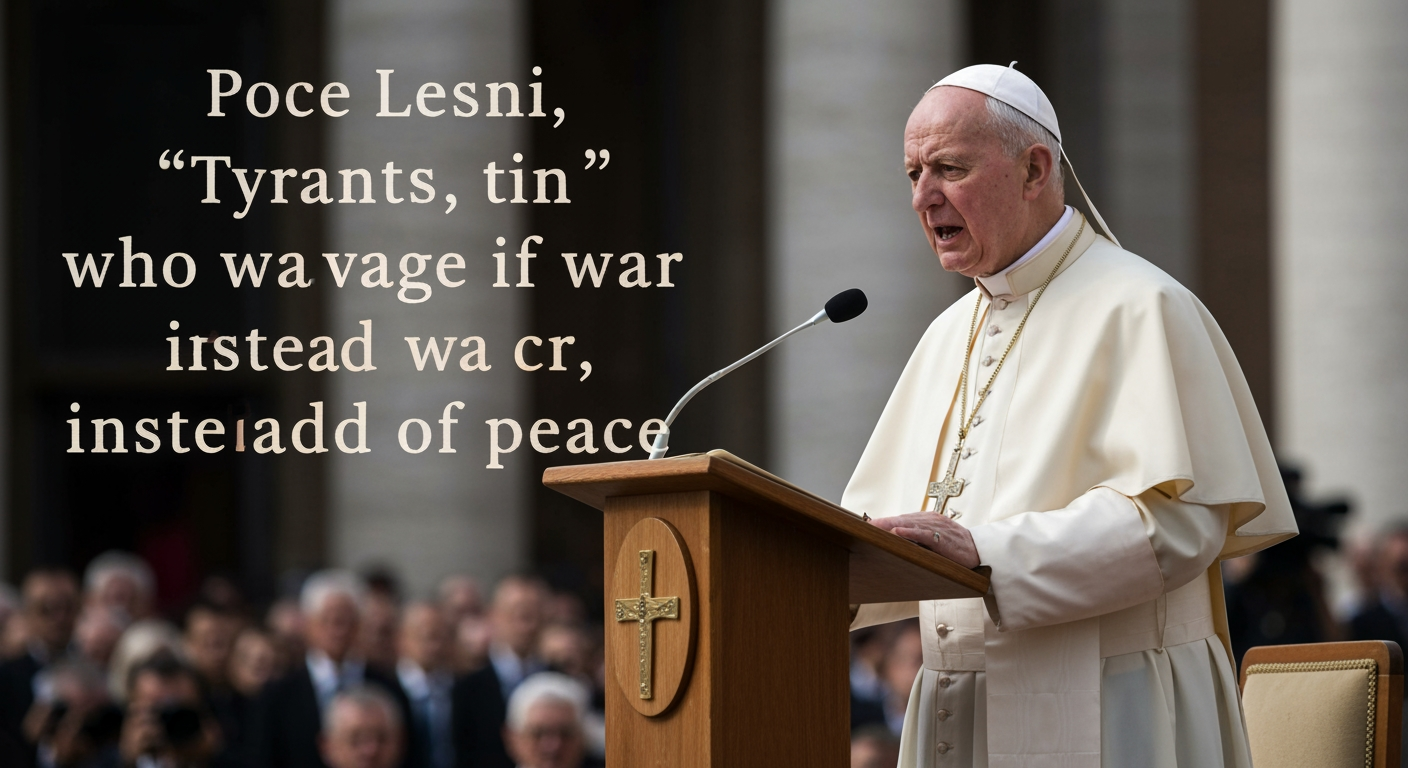
VATICAN CITY – Pope Leo XIV has issued a stern condemnation of what he termed a "delusion of omnipotence" driving the U.S.-Israeli war in Iran, delivering a powerful message against leaders who prioritize conflict over peace. The pontiff's remarks, made on April 11, 2026, underscore the Holy See's enduring commitment to diplomacy and its historical opposition to tyrannical actions that instigate warfare.
The Pope's statement signals a significant moral intervention in escalating global tensions, echoing a long tradition of papal concern for international stability and the welfare of populations caught in conflict. His use of the phrase "delusion of omnipotence" highlights a profound critique of national leadership that perceives itself as unchecked, pursuing self-interest or aggressive policies without regard for the broader human cost or the principles of justice. This latest papal address serves as a contemporary reminder of the Vatican's role as a moral voice in global affairs, consistently advocating for restraint and peaceful resolution in the face of militaristic fervor.
The Historical Papal Stance Against Tyranny and War
The Holy See has a well-documented history of critiquing forms of governance that deviate from the common good, often categorizing such rule as tyrannical. Historically, the concept of tyranny has been understood as a form of leadership where rulers operate outside the rule of law or for their own desires, rather than working towards the welfare of their populace. Such actions, when unchecked, were viewed as destructive to justice, disruptive to peace, and a betrayal of faith. Medieval papacy, for instance, held the power to declare the emergence of tyranny and even to depose monarchs if their rule led to widespread slaughter, highlighting the deeply ingrained papal concern for just governance and peace.
The current pontiff's excoriation of 'tyrants' waging war instead of peace aligns with this historical precedent. Throughout centuries, popes have often positioned themselves as moral arbiters, challenging rulers who engaged in unjust wars or oppressed their subjects. The historical understanding also posited that tyrants might engage in foreign wars to maintain control, induce poverty, and keep their own warriors occupied, thereby diverting internal dissent. This deep-rooted understanding of the motivations behind aggressive military actions provides a contextual framework for Pope Leo XIV's recent pronouncement, suggesting a timeless critique of power abused for destructive ends.
"Delusion of Omnipotence" in the Modern Geopolitical Landscape
Pope Leo XIV's specific reference to a "delusion of omnipotence" offers a contemporary lens through which to view the ongoing U.S.-Israeli war in Iran. This phrase points to a dangerous mindset where leaders or nations believe themselves impervious to consequences, operating under the assumption of absolute power and the right to impose their will without accountability. This perception of invincibility can lead to reckless decision-making, exacerbating conflicts and undermining diplomatic efforts. Such a mindset directly contradicts the papacy's consistent call for humility, dialogue, and multilateralism in international relations.
The "delusion of omnipotence" can be interpreted as a modern manifestation of tyrannical tendencies, where the pursuit of power and self-interest overrides ethical considerations and international legal frameworks. When leaders disregard the rule of law and the common good, preferring their own desires, it creates conditions ripe for prolonged conflict and human suffering. The Pope's statement, therefore, serves not only as a critique of specific actions but also as a broader moral indictment of the philosophical underpinnings of aggressive foreign policy. It implicitly calls for a re-evaluation of the principles guiding international engagement, urging a return to diplomacy and respect for sovereignty.
Implications for Peace and International Dialogue
The Vatican, as an independent sovereign state and a global moral authority, wields significant soft power. A direct condemnation from Pope Leo XIV, particularly one so sharply critical of powerful nations, carries considerable weight. Such a statement can galvanize international public opinion, encourage diplomatic pressure, and provide moral support for peace movements. By openly blasting the "delusion of omnipotence" and its role in fueling conflict, the pontiff sends an unequivocal message that aggressive war-waging is morally indefensible when pursued for self-serving motives rather than just peace.
Historically, papal declarations regarding peace and war have often sought to frame conflicts within a moral and ethical context, pushing political leaders to consider the humanitarian consequences of their decisions. The statement by Pope Leo XIV reiterates the papacy's consistent advocacy for peaceful conflict resolution, reminding nations that true leadership lies in fostering peace and justice, not in wielding power for destructive purposes. It underscores the belief that genuine peace cannot be achieved through military dominance or unchecked power, but through dialogue, mutual respect, and a commitment to the common good.
An Enduring Moral Appeal for Peace
Pope Leo XIV's excoriation of 'tyrants' waging war instead of peace, specifically in reference to the U.S.-Israeli war in Iran, serves as a poignant and timely reminder of the papacy's enduring moral appeal for global harmony. By challenging the "delusion of omnipotence" he highlights a core ethical concern: the abuse of power that leads to unnecessary conflict and suffering. This intervention is a continuation of a long-standing papal tradition of speaking truth to power, advocating for justice, and striving for a world where peace prevails over the destructive forces of war. The pontiff's words implore leaders to reflect on their actions, to reject the allure of absolute power, and to embrace the path of diplomacy and collaboration for the sake of humanity.
Sources
Related Articles

EU Court Delivers Landmark Ruling: Online Gamblers Can Seek Redress Under Home Law
LUXEMBOURG – In a pivotal decision poised to dramatically reshape Europe's online gambling landscape, the European Court of Justice (ECJ) has ruled that individuals who have incurred losses with unlicensed online...


Lufthansa Navigates Dual Turbulence: Fleet Restructuring Amidst Labor Strikes and Escalating Fuel Crisis
Frankfurt, Germany – Lufthansa Group finds itself at a critical juncture, grappling with significant internal restructuring compounded by external geopolitical pressures. The airline is moving to dismantle its regional...


Landmark Verdict: Jury Declares Live Nation-Ticketmaster a Harmful Monopoly, Reshaping Future of Live Entertainment
NEW YORK, NY – In a pivotal decision poised to reverberate throughout the live entertainment industry, a Manhattan federal jury on Wednesday found that Live Nation Entertainment and its subsidiary, Ticketmaster, operate...