EU Navigates Tumultuous Trade Waters After US Supreme Court Strikes Down Key Tariffs

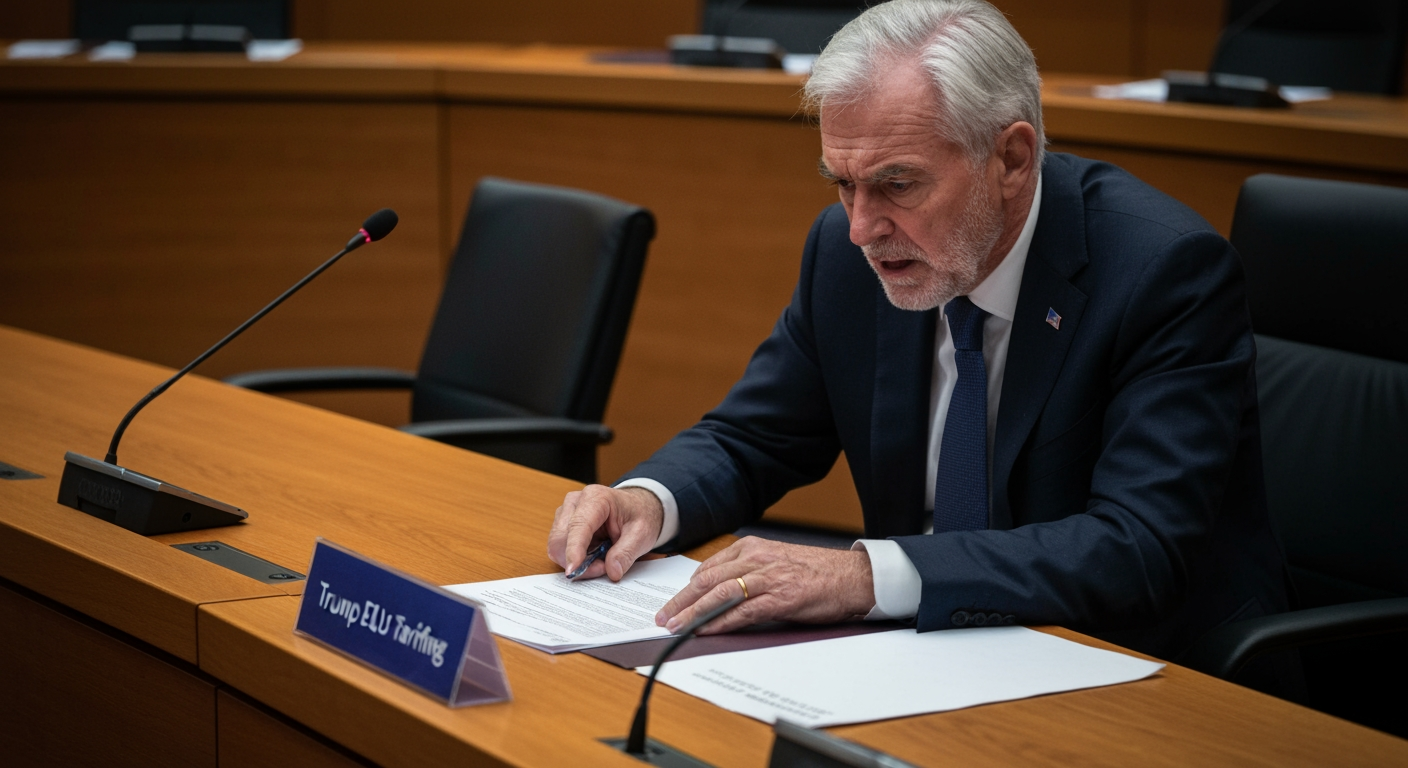
Brussels finds itself grappling with a complex and rapidly evolving trade landscape following a landmark United States Supreme Court decision that invalidated a significant portion of the tariffs previously imposed by President Donald Trump. While the ruling offers a glimmer of relief by deeming certain broad duties illegal, it simultaneously injects fresh uncertainty into the fragile transatlantic trade relationship, particularly concerning a recently brokered EU-US trade deal. The European Union, already poised to reactivate and expand its retaliatory measures against existing US steel and aluminum tariffs, is now meticulously analyzing the fallout, seeking clarity on Washington's next steps as global trade stability hangs in the balance.
The Supreme Court's Reshaping of Presidential Authority
On February 20, 2026, the US Supreme Court delivered a decisive 6-3 ruling in the cases of Learning Resources Inc. v. Trump and V.O.S. Selections v. United States. The high court declared that the International Emergency Economic Powers Act (IEEPA), which President Trump had utilized to levy a wide array of tariffs, does not grant the executive branch the authority to impose such duties. Chief Justice John Roberts, authoring the majority opinion, emphasized that the power to tax, including through tariffs, rests almost exclusively with Congress. This judgment effectively voids approximately 60% of the tariffs implemented under IEEPA, notably impacting a 15% blanket duty that had been applied to a broad spectrum of European exports to the US.
The ruling marks a significant judicial check on presidential power, with the court asserting that an expansive interpretation of IEEPA would "replace the longstanding executive-legislative collaboration over trade policy with unchecked Presidential policymaking". The decision was welcomed by various sectors in the US, with estimates suggesting it shields American taxpayers from a major tax increase and erases a substantial portion of anticipated federal revenue from these specific tariffs. However, the court explicitly left untouched tariffs imposed under other legal frameworks, most notably the Section 232 duties on steel and aluminum, justified on national security grounds, and Section 301 tariffs related to unfair trade practices. Consequently, the 50% tariffs on steel and aluminum remain firmly in place.
Brussels' Prepared Stance and Renewed Retaliation
Even prior to the Supreme Court's pronouncement, the European Union had been gearing up for a significant escalation in its trade dispute with the US. On March 12, 2025, Brussels announced a two-pronged strategy to counter the renewed and expanded US tariffs on European steel and aluminum products. This move came as the suspension of the EU's original retaliatory measures, which were put in place in 2018 and 2020 in response to the initial Trump tariffs, was set to expire on March 31, 2025. This suspension had been a product of negotiations under the Biden administration, aimed at allowing time to forge a Global Arrangement on Sustainable Steel and Aluminum (GASSA), a long-term solution that ultimately proved elusive.
The EU's announced countermeasures involve reactivating these suspended tariffs, which will affect approximately €8 billion worth of American goods beginning April 1, 2025. Additionally, the European Commission is preparing to implement a new package of tariffs on an estimated €18 billion worth of US exports by mid-April, in direct response to the broader scope of the most recent US tariffs. These measures are designed to economically balance the impact of the US tariffs, which reportedly affect €26 billion of European exports. European Commission President Ursula von der Leyen underscored the EU's position, stating, "Tariffs are taxes. They are bad for business, and even worse for consumers," while emphasizing the EU's preference for a negotiated resolution. The renewed retaliatory tariffs are expected to target iconic American products, echoing previous lists that included items such as bourbon whiskey, Levi's jeans, and Harley-Davidson motorcycles.
Uncertainty for the EU-US Trade Deal
The Supreme Court's ruling casts a long shadow over a meticulously negotiated EU-US trade deal, often referred to as the "Turnberry pact," agreed upon in July 2025. This agreement sought to cap US tariffs on most EU goods at 15%, a reduction from a threatened 30%, in exchange for EU investments in the US, significant purchases of US liquefied natural gas (LNG), and zero tariffs on certain US imports to Europe. However, the deal was predicated on the validity of the IEEPA tariffs that have now been struck down by the Supreme Court.
With the legal basis for these specific tariffs now invalidated, the future of the Turnberry pact is thrown into question. European officials are now seeking urgent clarification from the US Administration regarding the implications of the ruling for the broader trade deal. The EU Parliament had previously stalled the ratification of this deal in January 2026 amid unrelated tariff threats from President Trump, renewing plans for retaliatory levies on €93 billion in US goods. The current situation creates a new layer of complexity, as the very foundation of some of the agreement's concessions has been removed. Businesses on both sides of the Atlantic, particularly those in sectors like project cargo and heavy industrial equipment, are watching closely, as the tariffs on the steel and aluminum content within European machinery still apply due to the unaffected Section 232 duties.
The Path Forward: A Shifting Landscape
President Trump's immediate reaction to the Supreme Court's decision was one of "deep disappointment". Within hours of the ruling, he announced a new 10% worldwide tariff under Section 122 of the Trade Act of 1974. This swift pivot to a different legal mechanism signals a clear intent to continue pursuing his tariff-centric trade agenda, even if the tools for implementation must change. Section 122, generally used for balance-of-payments issues, allows for temporary import surcharges or quotas, though it typically imposes limits on duration and rates unless extended by Congress.
This ongoing uncertainty presents a formidable challenge for the EU. While the invalidation of IEEPA tariffs offers some respite for specific European exports, the continued presence of Section 232 steel and aluminum tariffs, coupled with the potential for new tariffs under Section 122 or other authorities like Section 301 or 338, means the threat of trade protectionism remains potent. Experts warn that the administration could target other key sectors, such as pharmaceuticals, semiconductors, or automotive components, in future tariff actions.
The economic consequences of this unpredictable environment are significant. The remaining Section 232 tariffs alone are projected to raise hundreds of billions in revenue over the next decade and impose costs on US households. For European industries, including those in Germany and Italy which are major exporters of steel and aluminum, the sustained tariffs have already led to decreased trade flows. The potential for new trade barriers, combined with the complexities surrounding refunds for previously paid IEEPA tariffs, contributes to an atmosphere of instability that is detrimental to international commerce.
In conclusion, the US Supreme Court's ruling on the IEEPA tariffs, while a significant legal development, has not simplified the intricate trade relationship between the European Union and the United States. Instead, it has created a dual challenge for Brussels: adapting to the invalidation of certain broad tariffs while simultaneously contending with President Trump's immediate pivot to new tariff mechanisms and the enduring impact of existing sector-specific duties. The EU continues to advocate for low tariffs and predictability in trade, yet it must remain prepared to defend its economic interests with "swift and proportionate countermeasures" in an environment where the foundations of transatlantic trade are continually being reshaped. The path ahead for EU-US trade remains fraught with legal and economic complexities, demanding careful navigation from both sides.
Related Articles


Russia's Enduring Nuclear Grip: A Geopolitical Lever Beyond Oil and Gas
While global attention frequently fixates on Russia's vast oil and gas reserves as instruments of geopolitical influence, a quieter, yet equally potent, form of leverage persists within its nuclear energy sector. Through its state-owned atomic energy corporation, Rosatom, Russia has cultivated deep-seated dependencies across the world, extending far beyond fossil fuel exports


Pentagon Demands Unfettered AI Access from Anthropic, Citing National Security Imperative
Washington D.C. — A high-stakes confrontation is unfolding between the U.S. Department of Defense and leading artificial intelligence firm Anthropic, as the Pentagon pressures the company to relinquish control over how its powerful Claude AI model can be used for military purposes

Energy Crisis Deepens European Divide as Druzhba Pipeline Standoff Escalates
Kyiv, Ukraine – A critical energy dispute surrounding the Druzhba oil pipeline, a vital artery for Russian crude into Central Europe, has intensified, creating fresh rifts within the European Union and complicating aid efforts for war-torn Ukraine. The southern branch of the pipeline, which supplies Hungary and Slovakia, has been offline since late January 2026, leading to a diplomatic standoff with accusations of political leverage and energy blackmail traded between Kyiv, Budapest, and Bratislava