Upholding the Prohibition of Force: The Enduring Struggle of UN Article 2(4)

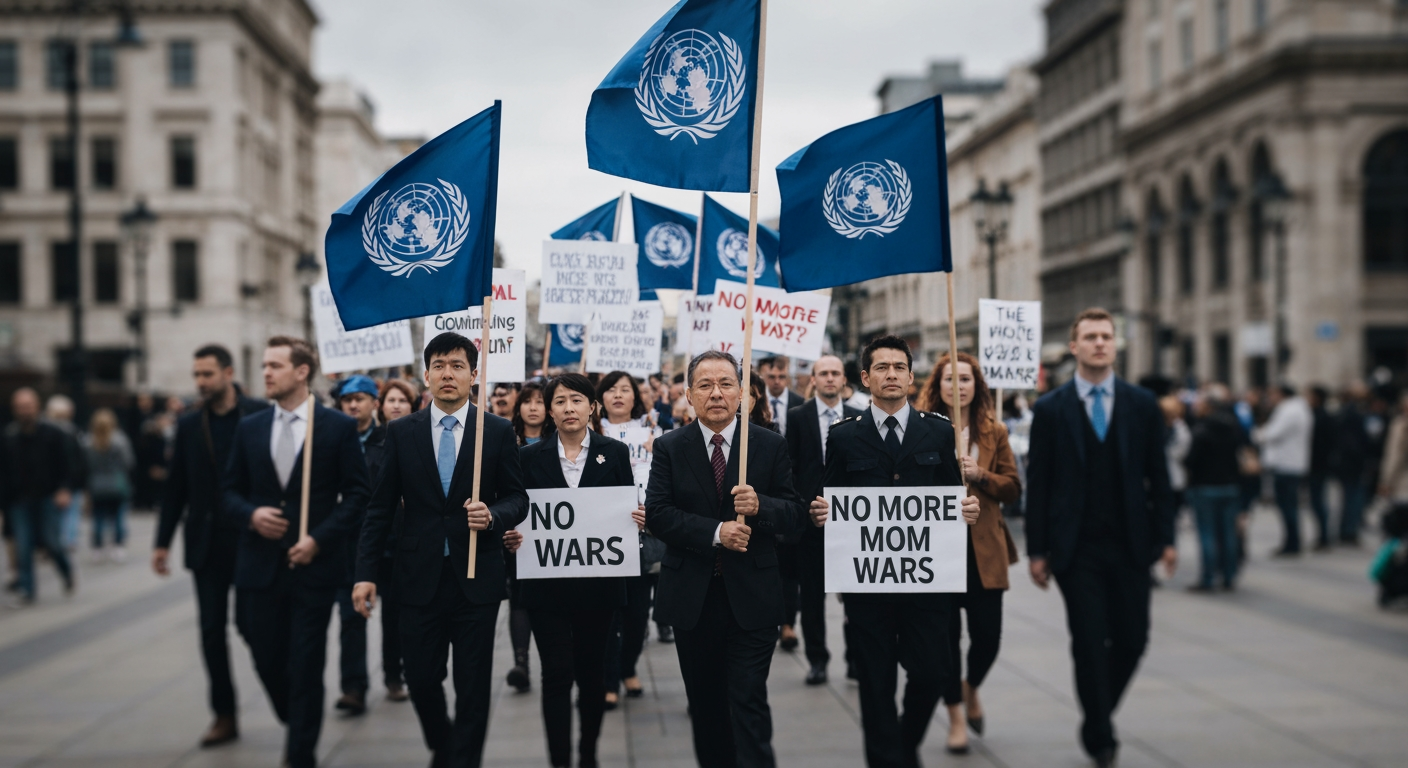
Seventy-nine years after its inception, Article 2(4) of the United Nations Charter stands as a foundational principle of international law, aiming to prevent states from resorting to armed conflict. Adopted in the aftermath of two devastating World Wars, this clause was designed to reshape global relations, moving away from unilateral aggression towards a system of collective security. Yet, its application and enforcement in a complex world continue to generate debate, highlighting the persistent tension between national sovereignty and the ambition for a peaceful international order.
Genesis of a Global Compact
The United Nations Charter, the founding document of the global organization, emerged from the profound devastation of World War II. Envisioned as an "international constitution," its primary goal was to safeguard future generations from the scourge of war, a vision partly shaped by the 1941 Atlantic Charter. Ratified overwhelmingly, the UN Charter represented a calculated national security strategy for many nations, aimed at establishing robust rules to curb aggression before it escalated into catastrophic conflicts. At the core of this new world order is Article 2(4), often described as the cornerstone of the Charter and a bedrock of the modern international legal system.
The text of Article 2(4) explicitly states: "All Members shall refrain in their international relations from the threat or use of force against the territorial integrity or political independence of any state, or in any other manner inconsistent with the Purposes of the United Nations." This provision obliges member states to respect borders and sovereignty, ensuring that international disputes are settled by peaceful means rather than military action. Its underlying purpose was to significantly raise the political and legal cost of aggression, narrow the justifications for employing force, and enshrine collective security as the default approach to international peace.
Defining the Red Line: What Constitutes "Force"?
While seemingly straightforward, the phrase "threat or use of force" in Article 2(4) has been subject to extensive legal interpretation and ongoing discussion. Generally, the prohibition is understood to apply to serious military actions, such as bombing a state's infrastructure, engaging its armed forces, or occupying its territory. Most legal theorists contend that Article 2(4) specifically targets military force, distinguishing it from non-military forms of coercion, like economic sanctions or cyberattacks. However, the Charter contains other provisions that may address these non-military forms of pressure. The ambiguity surrounding the precise threshold of what constitutes a "use of force" – particularly in an era of evolving technology and hybrid warfare – can be exploited by states engaging in "grey-zone operations" that test the boundaries of legality and risk escalation. The International Court of Justice (ICJ) has also clarified that a state can violate the prohibition on the use of force even without deploying its own troops, a concept known as "violation by proxy," as highlighted in the landmark 1986 Nicaragua v. United States decision.
The Permissible Exceptions: Self-Defense and Collective Security
Despite its sweeping prohibition, the UN Charter acknowledges two primary, and narrowly defined, exceptions to the use of force. The first is the inherent right to individual or collective self-defense, as preserved in Article 51 of the Charter. This article permits a state to use force if an armed attack occurs against it, but such a response must be both necessary and proportionate to the aggression. For collective self-defense, where other nations join in, a request from the attacked state is typically required to avoid violating its sovereignty. However, modern conflicts, particularly those involving large-scale terrorist attacks by non-state actors, have complicated the interpretation of self-defense, raising questions about whether such actions qualify as "armed attacks" and when a state may lawfully respond if another state provides material or tacit support to these groups. Legal experts caution against lowering the threshold for self-defense too far, fearing it could transform the Charter into a permissive system rather than a restrictive one.
The second exception is the authorization of force by the UN Security Council under Chapter VII of the Charter. This mechanism allows the Council to take action, including military force, to maintain or restore international peace and security. However, the use of collective military action is exercised sparingly, contingent on the political will and consensus of member states. The Security Council's structure, particularly the veto power held by its five permanent members (China, France, Russia, the United Kingdom, and the United States), can significantly impede its ability to authorize or enforce collective security measures, especially when one of these members is involved in a dispute. A third, albeit less explicit, exception to the prohibition involves instances where a state provides consent to armed intervention on its territory.
Navigating Modern Conflicts and Persistent Challenges
In the decades since the UN's founding, Article 2(4) has faced numerous challenges, with instances where its principles have been severely tested or overtly violated. Russia's invasion of Ukraine, for example, has been characterized by leading scholars as a "flagrant," "unambiguous," and "egregious" violation of Article 2(4). Other notable instances include the NATO intervention in Kosovo in 1999, the U.S.-led invasion of Iraq in 2003, and Russia's interventions in Georgia in 2008 and Crimea in 2014. These events underscore the UN's structural limitations, such as the absence of a centralized enforcement authority and the aforementioned veto power, which can enable powerful states to evade accountability when they violate the Charter.
A particularly contentious area of debate revolves around "humanitarian intervention" and the "Responsibility to Protect" (R2P) doctrine. While the moral impetus for using force to prevent mass atrocities is compelling, the legal case for such interventions without explicit Security Council authorization remains highly contested. Following events like those in Rwanda and Kosovo, the UN embraced the R2P framework, which posits that states have a responsibility to protect their own populations from atrocities, and if they fail, the international community should intervene. However, R2P reaffirms that only the Security Council can authorize the use of force, and many nations remain wary that "humanitarian" justifications can too easily become a pretext for political agendas or unilateral action.
Despite these recurring breaches and the perceived ineffectiveness in preventing all conflicts, Article 2(4) continues to hold significant sway in international discourse. It serves as a universal legal framework that compels states to articulate their actions in legally recognizable terms, even when those actions are controversial. This constant need to justify actions in the context of the Charter reinforces the existence of international rules and norms, shaping diplomatic responses and influencing global behavior.
An Enduring, Yet Tested, Framework
Article 2(4) of the UN Charter remains a cornerstone of the international legal order, a testament to the global community's aspiration for peace and collective security. While it has not eradicated war, it has fundamentally altered the discourse surrounding the use of force, shifting the burden of justification onto any state contemplating military action. The ongoing debates, interpretations, and challenges surrounding its application underscore that international law is a living constitution, constantly adapting to new geopolitical realities and emerging threats.
The commitment to the principle enshrined in Article 2(4) forces nations to engage in dialogue, to build consensus, and to seek diplomatic solutions before resorting to conflict. Though its enforcement can be imperfect, and its authority frequently tested by the unilateral actions of powerful states, the very act of invoking and debating Article 2(4) reinforces its relevance and the enduring global aspiration for a world where disputes are resolved peacefully. The struggle to uphold this critical prohibition continues, shaping the contours of international relations and defining the parameters of acceptable state conduct on the global stage.
Related Articles


German Professional Boxer Julia Igel Steps Up for Imane Khelif's Highly Anticipated Official Debut
Paris, France – The boxing world prepares for a pivotal moment as Algerian Olympic gold medalist Imane Khelif is set to make her official professional boxing debut on April 23 in Paris. Her opponent, Germany's Julia...


AI Reshapes the Workplace: The End of the Traditional Office, The Dawn of Intelligent Spaces
The rise of artificial intelligence, coupled with the persistent momentum of remote and hybrid work models, is fundamentally reshaping the landscape of commercial office spaces, prompting a critical re-evaluation of...

Iran War Threatens Billions in South Asian Remittances, Sparks Regional Economic Crisis
The escalating conflict in the Middle East, characterized by an ongoing "Iran war" involving the United States and Israel, has triggered profound economic instability across the Gulf, placing billions of dollars in...